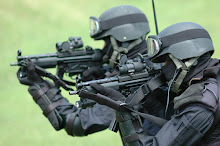
It is simply an opinion, but one shared by the majority of tactical teams at all levels in the United States. You can sense it the first time that you fire one. The MP5 is the culmination of countless efforts to blend reliability, controllability and firepower into a small package. With the MP5, that design objective has been achieved. The MP5 is that by which all other designs are judged.
Appearing in countless movies of late, it does not have the catchy name of some guns that have been demonized by the press and some politicians, who quake in fear at the mere mention of names like 'Uzi' or 'Tec 9' or 'MAC 10.' Your average street criminal might not know what to call the greatest submachine gun ever designed. Chances are, if you laid one down next to a Tec 9 and asked the criminal to choose one, he might opt for the Tec. So much for good taste. There are many photographs of the MP5. I will share some of my favorites with you here. Just for the record, many published articles designate the MP5 as thus: "MP-5." Not correct. There is no hyphen.
MP5 Timeline From "Project 64" by Frank W. James
1964: HK designer Tilo Möller, Manfred Guhring, Georg Seidl and Helmut Baureuter start design work on "Project 64" --the beginning of the MP5.
1966: The first production MP5 is officially introduced, but by mid-1966, the German Border Police adopt the MP5. Also the first foreign sale was to the Swiss Procurement Department for Arms when the Swiss Police adopt the MP5.
1968: The first blank-firing attachments made for the MP5.
1971: First series of modifications and improvements made to the MP5:
* Serrations removed from bolt group.
* Trigger pull lightened for improved accuracy
* Bolt carrier shortened from previous long extension carrier
* Ejection port lengthened (front to back) and a piece riveted to the rear portion to lower the profile and improve case ejection.
1972: Radius changed on chamber from 2mm to 2.5 mm for improved feeding.
1973: The synthetic trigger housing was strengthened with glass fiber.
* The pistol grip changed from the closed, glued on end cap to the hollow open design extant even today.
* The shape of the buttplate is changed from convex to concave
* The scope mounting points are added to the top of the stamped steel receiver for use with the HK quick-detach scope mounting system.
* The R3/3 sling system is introduced.
1974: The first prototype for the MP5SD is designed and built
1975: A new cocking lever is designed for the MP5
1976: The MP5K or Kurz model is developed at the request of a South American sales representative of HK.
1977: A special lacquer coating is developed for increased corrosion resistance on guns sold for export.
1978: Testing begins on the special MP5K firing briefcase.
1978: The rubber buffer is added to the retractable sliding buttstock.
1978: Extensive environmental testing iis completed on the new retractable buttstock.
1978: The tropical or "Export" forearm is tested.
1978: Testing of the new MP5 extractor spring completed.
1979: New MP5 Extractor spring introduced. For identity purposes, it is copper colored.
1980: Bushings in the rear of the MP5 receiver are strengthened by a different welding process.
1982: A new three round burst trigger group with four settings and a polymer housing is introduced.
1983: A special locked bolt version of the MP5SD is tested.
1984: The MP5PT is introduced. Designed specifically for use solely with Dynamit Nobel's plastic training ammo, it cannot fire live ammunition.
1985: Comparison testing conducted between the standard MP5SD and different versions of the SMGI, SMGII and MP2000.
1988: The "Maritim" MP5 is introduced. The Maritim is a special MP5 designed for a saltwater environment. It features special corrosion resistant coatings and finishes.
1988: Chamber flutes are installed by an EDM process, instead of broaching. Additionally, the number of chamber flutes is increased from 12 to 16.
1989: The height of the ejector is raised by .5 mm.
1989: The SP89 is introduced.
1989: Manufacture of the retractable buttstock is changed, with the buttplate being molded onto the buttstock metal.
1990: A special "SEF" trigger group is introduced that "locks out" the full auto function. Full auto fire is achieved when the right end of the safety lever is depressed, to allow the safety/selector lever to the full auto setting.
1991: Improvements made to the bolt head and chamber face. Also the contact moment was changed on the ejector in relation to the bolt group.
1991: The roller holder is changed from the flat plate to a spring or wire type holder previously seen on the HK23E.
1991: Angle on the locking piece for the MP5SD is changed from 120 degrees to 115 degrees.
1991: The PDW folding stock is developed by HK Inc. in the U.S. for personal defense and VIP protection details. When fitted to the MP5K, it allows the short MP5K to be fired from the shoulder, greatly enhancing accuracy.
1992: The MP5 in 10mm Auto and .40 S&W is introduced.
1999: The MP5F is developed and introduced.
2000: The MP5/10 and MP5/40 are discontinued.